
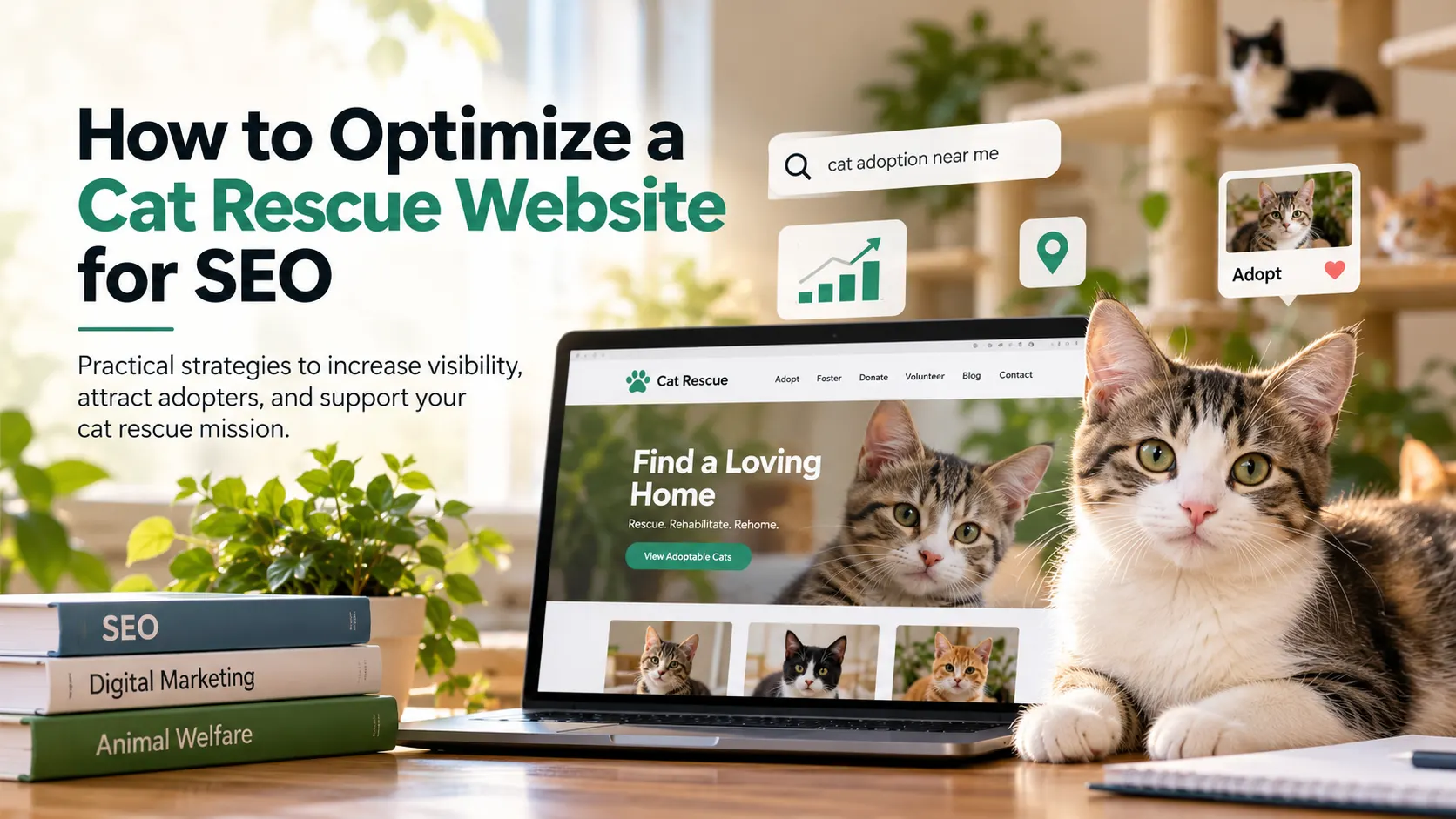
A well-run cat rescue can still stay invisible if the people ready to adopt, foster, volunteer or donate never find its website.
Learning how to optimize a cat rescue website for SEO is not just about Google rankings. It is about connecting cats in need with people who can help them. A properly optimised site makes adoptable cats easier to find, helps local families trust your rescue, and attracts regular support.
Rescue websites have several goals at once: adoption, mission, care resources, volunteers and fundraising. This guide shows a practical, long-term approach that supports both search visibility and animal welfare.
1. Why SEO matters for cat rescue websites
Having a website does not guarantee visibility. Search engines must understand your content, discover your pages and decide they are useful for a search. A thoughtful SEO strategy bridges that gap.
Reach more potential adopters
Many people start online with searches like “cat adoption near me”, “adopt a kitten in [city]” or “adult cats looking for homes”. Clear adoption pages with accurate location details help you appear for them.
Increase donations and foster applications
Someone who cannot adopt may still foster, donate food, fund medical care or volunteer. Dedicated pages make each route obvious.
Build credibility and trust
Visitors want proof you are legitimate: clear mission, contact details, adoption fees, veterinary information, real photos and secure donations.
Reduce reliance on paid ads
Organic search takes time and upkeep, with no guaranteed results, but evergreen content and strong adoption pages keep attracting visitors long after publication.
2. Understand search intent before optimising
Search intent is the reason behind a query. For a cat rescue, four types matter most.
“Adopt a rescue cat near me”
Send visitors to listings, cat profiles, eligibility criteria and the application form.
“Cat rescue centre in Manchester”
Give accurate location, contact details, opening hours and the help you offer.
“How to care for an adopted kitten”
Publish guides on settling in, feeding, socialisation, vet care and responsible ownership.
“Donate to a cat rescue charity”
Create dedicated donation, fostering, volunteering and sponsorship pages.
A long article on the history of domestic cats may attract readers, but it will not satisfy someone who wants to adopt today. Give each page one clear purpose, and link naturally between them. Google’s guidance recommends people-first content rather than pages built to manipulate rankings.
3. Conduct keyword research
Find the phrases adopters, donors and volunteers use, then assign each to the correct page.
| Keyword group | Example keywords | Recommended page |
|---|---|---|
| Main service | cat rescue, cat rescue organisation | Homepage |
| Adoption | adopt a cat, rescue cats for adoption | Adoption landing page |
| Local | cat rescue in [city], cat adoption near me | Location or service page |
| Kittens | adopt a kitten, kittens available for adoption | Kitten listings |
| Fostering | foster a rescue cat, cat fostering programme | Foster page |
| Donations | donate to cat rescue, support rescued cats | Donation page |
| Volunteering | cat rescue volunteer opportunities | Volunteer page |
| Education | bringing home a rescue cat | Blog articles |
These are seed keywords, not verified search volumes. Confirm demand and difficulty with your tools.
Useful tools
- Google Search Console shows queries already bringing visitors.
- Google Keyword Planner explores ideas and estimated demand.
- Google Trends compares interest over time.
- Ahrefs or Semrush investigate competitors and backlinks.
- Autocomplete and related searches reveal how people phrase questions.
Prioritise long-tail and local keywords
Specific phrases such as “adopt an adult rescue cat in [city]” or “how to introduce a rescue cat to another cat” show what a searcher actually needs. If you serve a place like Leeds, research “cat rescue Leeds” or “foster cats Leeds”, but create location pages only for areas you genuinely serve.
Three near-identical pages targeting “cat adoption near me” compete with each other. Give each page one job: main adoption page, individual cat profiles, foster page, and advice articles. Improving an existing page often beats publishing another.
4. Build an SEO-friendly website structure
Visitors should find available cats, donation details and the application without digging through menus.
Homepage
Mission, impact, available cats and key actions.
Adoption
Available cats, profiles, application process.
Get Involved
Donate, foster, volunteer, sponsor.
Our Organisation
About, team, policies, contact.
Clear, descriptive URLs
- /adopt-a-cat/
- /foster-a-cat/
- /donate/
- /cat-care/how-to-settle-a-rescue-cat/
- /cats/milo/
Use descriptive anchor text such as “view cats available for adoption” instead of “click here”. If you must change an established URL, add a relevant permanent redirect and update internal links and sitemaps.
XML sitemap
Include canonical, indexable pages: homepage, main service pages, current adoption listings and useful articles. A sitemap does not guarantee indexing. Submit it in Search Console and investigate important pages that stay unindexed.
5. Optimise adoption pages and cat profiles
These pages connect search visibility with your mission. A grid of photos alone leaves visitors without the information they need.
Main adoption landing page should explain
- Which cats are currently available and where you operate.
- How adoption works and whether applications are open.
- Any fees, requirements and how to ask questions.
Use a clear heading such as “Cats Available for Adoption in [City]”, but only if it reflects your true service area.
Each cat profile should include (where known)
Name and recent photographs
Approximate age or date of birth
Personality and activity level
Compatibility with children or pets, from reliable assessment
Verified medical and vaccination details
Special care needs
Foster arrangement, if safe to share
Adoption status and last-updated date
Application steps and contacts
A good profile answers
What is this cat like? What home may suit them? What should an adopter do next?
Do not make up personality traits, medical facts or compatibility claims to make a profile more appealing. Write a unique description for each cat instead of swapping only the name in a template.
Keep status accurate
Outdated listings are the biggest practical problem. Update status as soon as a cat is adopted, then either keep the page as a success story pointing to available cats or remove it from active listings. Avoid redirecting every adopted-cat page to the homepage. Automate status updates in your CMS if possible and run a weekly review.
6. Improve on-page SEO elements
Title tags
| Page | Suggested SEO title |
|---|---|
| Homepage | Cat Rescue and Adoption in [City] | [Organisation] |
| Adoption page | Cats Available for Adoption in [City] |
| Foster page | Foster a Rescue Cat in [Region] |
| Donation page | Donate to Help Rescued Cats | [Organisation] |
| Blog article | How to Help a Rescue Cat Settle Into a New Home |
Meta descriptions
Summarise what visitors can expect. They are not a guaranteed ranking boost and Google may rewrite them.
Meet cats looking for loving homes in [City]. Learn about their personalities, adoption requirements, and how to apply to welcome a rescue cat into your family.
Logical headings
One H1, then descriptive H2s such as “Meet Our Cats”, “How Our Adoption Process Works”, “Adoption Requirements and Fees”, “Frequently Asked Questions” and “Contact Our Adoption Team”. Never add headings only to insert keywords.
A 2% keyword density is not a Google ranking requirement. Use the main phrase naturally in the title, intro or a relevant heading, and use variations like “cat rescue website SEO strategy”. Relevance, completeness and user experience matter more.
7. Strengthen local SEO and Google Business Profile
Local SEO helps people find you if you run a shelter, host adoption events, arrange foster placements or accept local applications.
Set up an accurate Google Business Profile
- Correct organisation name and appropriate category.
- Verified address, or service area where supported.
- Accurate opening hours, contact details and website URL.
- Recent photos of facilities, volunteers and cats.
Not every rescue is eligible. An online-only rescue should not create a misleading listing. Google says local results depend mainly on relevance, distance and prominence.
Create genuinely useful location pages
Include services in that area, applicant radius rules, event locations, local fostering and contact details. Avoid dozens of pages where only the city name changes.
Earn local links and collect feedback responsibly
Build relationships with vets, welfare charities, community groups, local news, pet-friendly housing groups, schools and event partners. Respond professionally to public feedback.
Never offer incentives for positive reviews, pressure adopters for ratings, or publish applicants’ private information.
8. Create helpful cat rescue blog content
Start from real audience needs. Do not publish high volumes of generic articles just to add indexed URLs.
Develop content clusters
Pillar page
The Complete Guide to Adopting a Rescue Cat
Preparation
Preparing your home, essential supplies, choosing the right cat.
Settling in
First week, safe spaces, introductions and routine.
Health and welfare
Vet visits, preventive care, behaviour concerns.
Topic ideas
- How to Prepare Your Home for a Rescue Cat
- What to Expect During the Cat Adoption Process
- Adopting a Kitten vs. an Adult Cat: What to Consider
- How to Introduce a Rescue Cat to Other Pets
- What Does It Mean to Foster a Rescue Cat?
- How to Help a Local Cat Rescue Without Adopting
- Questions to Ask Before Adopting a Rescue Cat
These are ideas, not keyword-volume claims. Validate them with search data first.
Make every article informative, current and credible
Explain the issue, why it matters, practical steps, common mistakes and when to seek professional help. Use reliable veterinary and welfare sources, and separate general guidance from individual vet advice. Original photos and real examples from your work beat copied generic advice. Refresh older posts with substantive updates, never by only changing the date, and check Search Console before rewriting a post that already gets traffic. For SEO details, rely on Google Search Central documentation.
9. Technical SEO improvements
Audit crawling and indexation
- Important pages not indexed, and accidental noindex tags.
- URLs blocked by robots.txt.
- Broken links, redirect chains and loops.
- Duplicate URLs and conflicting canonicals.
- Wrong status codes and outdated sitemap entries.
Not every excluded URL is an error: filtered listings, expired profiles and admin URLs often need no indexing.
Make adoption listings crawlable
If JavaScript displays your cats, confirm each profile has a unique, crawlable URL and that key content appears in the rendered page. Test with URL Inspection rather than assuming.
Core Web Vitals
These are Google’s good thresholds at the 75th percentile of visits. Quick wins: compress photos, use WebP or AVIF, lazy-load below-the-fold images only, reserve image dimensions, trim third-party scripts, improve server response and caching, and test on mobile. Use PageSpeed Insights and Search Console.
Structured data
Relevant types include Organization, Article or BlogPosting, BreadcrumbList, WebSite and Event for eligible public events. Use only types that accurately describe the page, never veterinary clinic markup if you offer no veterinary services, and validate with the Rich Results Test.
Google removed its FAQ rich result from Search in May 2026. FAQs still help visitors, but FAQ schema will not bring back that result. Check Search Central updates before following older tutorials.
10. Image SEO and website accessibility
- Use genuine, clear photos with descriptive file names like
grey-rescue-cat-luna.webp. - Compress without blurring, use modern formats and responsive sizes.
- Keep listing-grid dimensions consistent and place images near relevant text.
“Luna, a grey rescue cat resting on a blanket”
“cat cat rescue cat adoption best cat rescue”
Describe only what is visible. Decorative images can use an empty alt attribute.
Accessibility checklist
- Sufficient colour contrast and visible form labels.
- Buttons that describe their purpose.
- Keyboard-friendly navigation and logical heading order.
- Error messages that explain the fix.
- No information conveyed by colour alone.
11. Build trust, authority and quality backlinks
Earn links from local newspapers, vets, welfare organisations, community sites, schools and event partners. Focus on relevance and the real value of the relationship.
Do not buy large volumes of backlinks, use automated link building or publish low-quality guest posts. A few relevant, editorially earned links are a stronger foundation.
Publish original rescue stories
With permission and privacy safeguards, share recovery journeys, foster experiences, donation impact and advice from experienced carers. Use real details and accurate outcomes, and never use distressing stories to pressure readers.
Show who you are
- About page with mission and history.
- Team, trustees or volunteers where appropriate.
- Transparent fundraising and registration details.
- Adoption and privacy policies, and complaint handling.
- Qualified review of health-related content.
12. Improve mobile experience and conversions
- Readable text without zooming and easy menus.
- Correct photo display and forms that work on small screens.
- Tap-friendly buttons, fast donation pages and visible contact details.
Test the whole journey on a real phone. Use clear calls to action: View Cats Available for Adoption, Start Your Adoption Application, Learn About Fostering, Donate to Support Cat Rescue, Volunteer With Our Team.
Measure goal completions
Track adoption applications, qualified enquiries, foster applications, completed donations, volunteer sign-ups and clicks on contact details. If traffic grows but applications do not, check intent match, form complexity and whether visitors have enough information.
14. Track SEO performance and adoption outcomes
Set up reporting before making major changes. In Search Console, monitor impressions, clicks, click-through rate, average position, indexing and queries, segmented by page and query. In Google Analytics, track application starts and completions, foster and volunteer forms, donations and contact clicks, respecting privacy and consent rules.
| Metric | What it tells you | Review |
|---|---|---|
| Organic clicks | Search traffic reaching the site | Weekly or monthly |
| Relevant impressions | Visibility for target topics | Monthly |
| Landing-page CTR | How often impressions become clicks | Monthly |
| Indexed priority pages | Whether key pages can appear | Monthly |
| Organic adoption enquiries | Adoption interest from search | Monthly |
| Foster applications and donations | Support from organic visitors | Monthly |
| Page performance | Slow or unstable pages | Monthly and after changes |
Compare similar periods and account for seasonality and cat availability. Fewer enquiries may simply mean fewer available cats. SEO has no guaranteed ranking or timeline, so judge progress by trends and meaningful actions.
15. A practical 90-day cat rescue SEO plan
Fix the foundations
- Verify Google Search Console.
- Audit indexation, redirects, broken links and canonicals.
- Review titles and meta descriptions.
- Check mobile usability and speed.
- Identify key adoption, donation and foster pages.
- Update inaccurate or outdated listings.
Improve pages and content
- Finish keyword research and map queries to URLs.
- Improve the main adoption page and cat profiles.
- Optimise image sizes, names and alt text.
- Publish two or three useful articles.
- Add internal links between articles and service pages.
Build visibility and measure results
- Improve eligible local listings.
- Reach out to local partners.
- Publish supporting content where demand is validated.
- Review queries and landing-page performance.
- Track adoption, foster and donation conversions.
- List priorities for next quarter.
Suggested weekly workflow
One technical or on-page task, one content improvement, one listing-accuracy review, one outreach activity, and a short Search Console and conversion check. Accurate listings and key technical fixes come before extra articles.
16. Common SEO mistakes to avoid
Keyword stuffing
Repeating one exact phrase makes writing awkward. Use natural language and related terms.
Duplicate adoption descriptions
Swapping only the cat’s name hides what makes each animal different.
Adopted cats still listed
Outdated listings frustrate adopters. Update status and offer a next step.
Thin location pages
Near-identical town pages add little. Publish them only with real local information.
Buying irrelevant backlinks
Manipulative links add risk. Focus on credible relationships.
Ignoring mobile or measuring rankings alone
Test the full mobile journey and track enquiries, applications and donations too.
17. Frequently asked questions
How do you optimize a cat rescue website for SEO?
Identify your goals, research relevant keywords and improve adoption, fostering, donation and location pages. Then address technical SEO, speed and image accessibility, publish useful content, strengthen local visibility, and measure organic traffic alongside adoption and donation outcomes.
Which keywords should a cat rescue website target?
Examples include cat rescue, cat adoption, rescue cats available for adoption, foster a rescue cat, donate to a cat rescue and local searches. Choose terms based on your real services, audience needs, demand and competition.
How can a cat rescue rank in local search?
Keep eligible profiles accurate, create useful location pages, use consistent contact details and build community relationships. Local rankings depend on relevance, distance and prominence, so no single step guarantees a top position.
How often should a cat rescue publish blog posts?
One or two substantial articles a month is a reasonable start for a small team, but no frequency guarantees rankings. Updating important existing pages can beat publishing unnecessary new ones.
Does keyword density need to be 2%?
No. Google does not require it, and a fixed percentage produces repetitive writing, especially with long phrases.
Should every available cat have its own page?
Yes, when the page holds meaningful information and gives adopters a stable URL, alongside a main listing page. Decide how to handle adopted-cat pages so you do not build up empty, duplicate or outdated URLs.
What is the role of structured data?
It helps search engines understand your organisation, articles, breadcrumbs and eligible events. Use accurate schema types and validate them. It does not guarantee rankings or special features.
Can social media improve SEO?
It can raise awareness and bring referral visitors, but social engagement is not a guaranteed ranking factor. Its value is reaching people and encouraging action.
How long does cat rescue SEO take?
It varies with your site’s condition, competition and content quality. Technical fixes can show results quickly, while stronger visibility often takes months. Measure trends and completed applications, not a fixed deadline.
How can AI search and answer engines support visibility?
Start with the same fundamentals: accurate information, accessible pages, clear headings, original experience, trustworthy sources and useful answers. Google’s May 2026 guidance on generative AI search features still stresses established SEO practices and non-commodity content. There is no guaranteed shortcut into AI-generated answers.
Build a website that helps more cats find homes
Start with a sound technical foundation, then add informative adoption pages, accurate profiles, useful articles, local visibility, accessible photos and steady measurement. Often the best improvement is simple: update a listing, fix a form, or explain adoption more clearly.
View cats available for adoption
13. Use social media and outreach to support SEO
Social platforms can introduce your rescue to people who never searched for it. Mix available cats, adopter advice, foster experiences, event announcements, project updates and ways to give. Link to the most relevant page, not always the homepage.
Add accurate Open Graph titles, descriptions and preview images, and only use photos you have permission for. Social engagement is not a guaranteed ranking factor, but it brings referrals and reach.
Help first and link only when it adds value. Never spam threads, fake recommendations or disguise promotion as independent advice.