
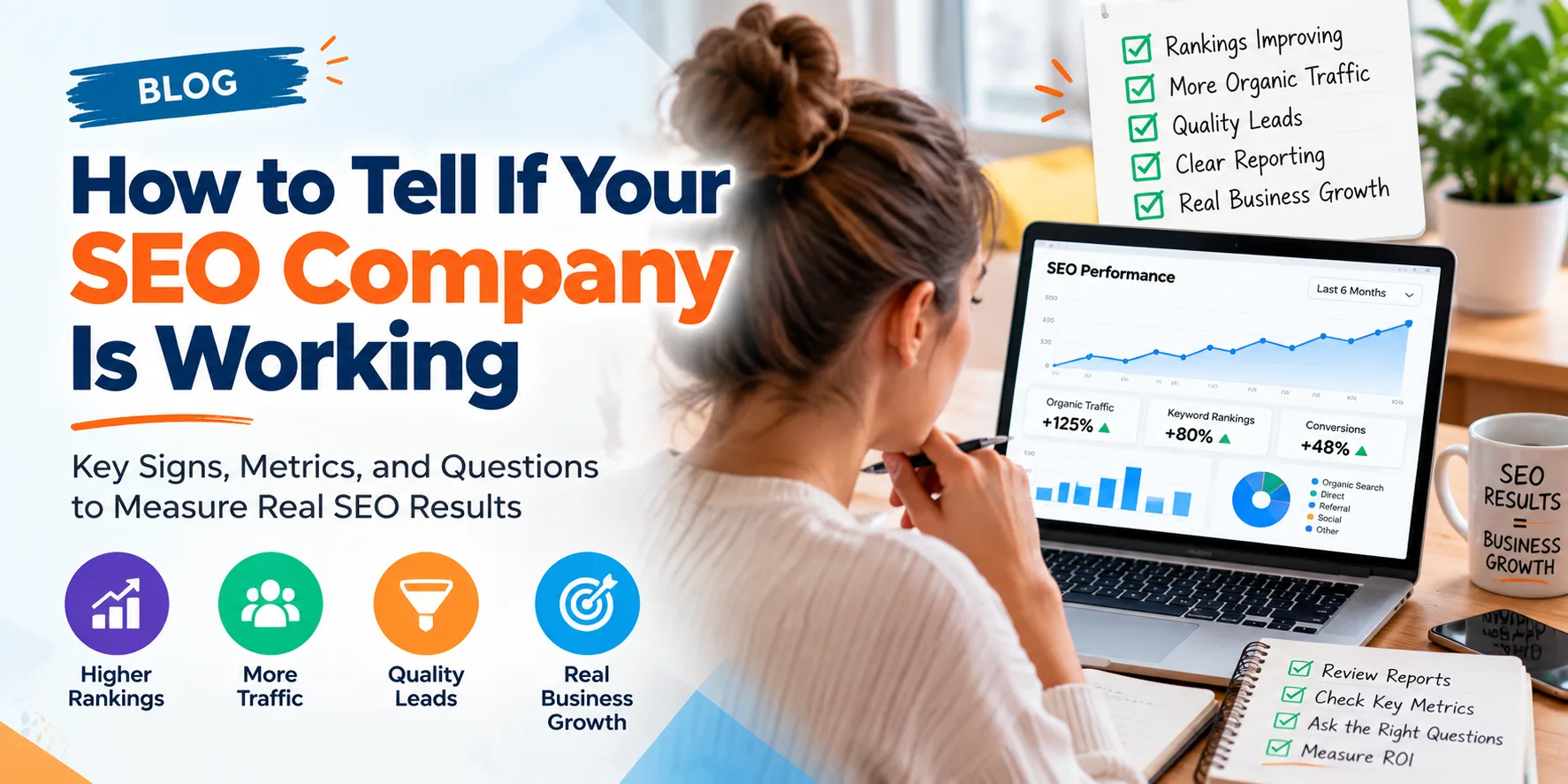
You pay for better visibility, qualified visitors, stronger leads and more sales. But SEO is slow, and weekly progress is rarely obvious.
So how do you tell if your SEO company is working, without relying on promises, attractive reports or rankings for keywords that bring no business? Look beyond rankings. A reliable partner can explain what was done, what improved, what still needs attention, and how it connects to your goals.
This guide covers the metrics to monitor, warning signs, questions to ask, a 90-day review plan, and how AI search changes measurement.
1. What does a successful SEO campaign look like?
SEO is more than reaching page one. It combines technical improvements, useful content, search intent, site structure, authority and user experience so the right audience can find and use your site.
An accounting firm may gain visitors from tax searches, but if they leave without contacting the firm, traffic alone proves little. An online store may rank for more products, but the real outcome is shoppers who buy. Consider four levels of progress:
Search visibility
Your site becomes eligible for more relevant searches and gains impressions.
Qualified organic traffic
More relevant people arrive from unpaid results and engage with matching pages.
Leads and conversions
Visitors submit forms, request quotes, book consultations or buy.
Business impact
SEO contributes to revenue, customer acquisition or another defined goal.
These levels do not improve together. Technical work may come before rankings, and traffic may rise before conversions. What matters is whether your agency can explain how its work relates to the results.
2. How long should SEO take to show results?
Search engines need time to discover, crawl, index and assess changes. Google Search Central says changes can take anywhere from a few days to several months to show in results.
| Period | What you may reasonably review |
|---|---|
| First 30 days | Audit, baseline measurements, technical issues, keyword research, strategy and priorities |
| Days 31–60 | Technical fixes, content improvements, internal linking, indexing checks, early visibility changes |
| Days 61–90 | Trends in impressions, clicks, rankings, landing-page performance and early conversions |
| Months 4–6+ | More meaningful patterns, depending on competition, speed of implementation and site history |
This is a planning framework, not a guaranteed schedule. Even before revenue grows, your agency should show tangible progress: fixed indexation problems, improved landing pages, researched content, stronger internal links. But completed tasks are not the same as successful outcomes, so ask for both what was done and the evidence it helps. If months pass with no visible progress, request a detailed review.
3. 12 signs your SEO company is working
Combine evidence of completed work, measurable improvement and a clear plan for the next stage.
A clear SEO strategy
Your agency understands your audience, competitors, services and goals, and can link each keyword group to a page and a business objective.
Improving search visibility
Impressions, new queries and positions for valuable terms grow. More impressions without clicks may just mean titles and snippets need work.
More relevant organic traffic
Relevance beats volume. 2,000 extra research visits with no extra demo requests is awareness, not necessarily commercial progress.
Key landing pages improve
Service, product, location, pricing and contact pages get better content, titles, links and calls to action.
Technical problems get resolved
Issues are documented, explained by business impact and tracked. One indexation fault on key pages outweighs many minor warnings.
Content is more useful
Pages answer questions clearly, show expertise and link to related resources. Two improved pages beat ten thin articles.
Internal linking improves
Relevant links, descriptive anchors, fewer orphan pages and fixed broken links.
Relevant backlinks are earned
Ask for sources and methods. Be wary of promised monthly numbers of “high-authority” links.
Visitors take meaningful actions
Forms, calls, bookings, quotes and purchases are tracked correctly, so traffic can be tied to results.
Clear communication
You hear what was done, what changed, what did not work and what happens next, without chasing.
The agency adapts to evidence
When data shows a problem, such as high impressions with few clicks, it investigates and tests a response.
SEO supports business growth
Your agency explains how SEO contributes to the customer journey and what the data can and cannot prove.
4. The most important SEO metrics to track
Focus on a small set of meaningful metrics rather than dozens of charts. The right ones depend on your business model.
| Metric | What it tells you | What to look for |
|---|---|---|
| Search impressions | How often your site appears in eligible Google results | Visibility for relevant queries |
| Organic clicks | Clicks from Google Search to your site | Growth in relevant visits |
| Average position | Average position of your topmost result | Directional movement for target queries |
| Click-through rate | Share of impressions that become clicks | Whether listings attract clicks |
| Organic sessions | Visits attributed to organic search in analytics | Changes over time |
| Conversion rate | Share of visits completing a defined action | Whether traffic produces outcomes |
| Qualified leads | Enquiries matching your target customer | Quality and commercial relevance |
| Organic revenue | Revenue attributed to organic search | Commercial contribution |
| Technical health | Status of crawling, indexing and page experience | Serious barriers being resolved |
| Content performance | Results for priority pages and groups | Visibility, clicks and conversions by page |

Why keyword rankings are not enough
A keyword may rank well because it has little competition yet bring no business, while another may move from page four to two and still earn few clicks. Rankings also vary by query, location, device, search features and time, so one manual search cannot judge a campaign. Ask your agency to tie keyword tracking to impressions, clicks, landing pages and conversions.
How to calculate organic conversion rate

For example, 1,000 organic sessions and 30 tracked conversions in the same period gives a session-based conversion rate of 3%. This is an illustration, not a benchmark. Definitions, tracking and sales cycles differ, so compare periods using one consistent method.
Why leads and revenue deserve attention
Rankings and traffic can rise without more customers. When that happens, check the whole journey. Common causes:
- The traffic is informational, not commercial.
- The landing page does not answer the visitor’s question.
- The offer is unclear or uncompetitive.
- The contact process is hard to use.
- Conversion tracking is incomplete.
- Sales follow-up is weak, or the buying cycle is longer than the reporting window.
5. How to check SEO performance using official tools
You do not have to rely only on your agency’s reports. Official tools let you verify the key parts yourself.
Google Search Console
- Open the Performance report and compare the last 28 days with the previous 28, or year over year for seasonal sites.
- Review total clicks and impressions, and the queries producing visibility.
- Use the Pages view to find your strongest and weakest landing pages.
- Investigate sudden drops and position changes.
- Check indexing reports and inspect individual URLs when needed.
Data can be filtered by query, page, country, device and date.
Know its limitsSearch Console reports Google Search performance only. It does not measure every search engine or prove a visitor became a customer.
Google Analytics 4
Go to Reports → Acquisition → Traffic acquisition and look at the Organic Search row. Useful measures include organic sessions and users, engagement rate, key events like form submissions or purchases, ecommerce revenue and organic landing pages.

Verify tracking firstMissing form events, duplicate purchase events, consent gaps and wrong channel attribution can all distort results before you judge your agency.
PageSpeed Insights
Check important landing pages on mobile and desktop for large images and render-blocking resources. A perfect score does not guarantee rankings.
Google Business Profile
For local businesses, check information, service areas, reviews and performance data. No one can promise rankings in every nearby location.
A simple monthly routine
Review search visibility
Clicks, impressions, queries, target pages and big changes.
Review technical and content work
Verify fixes, published content, indexing checks and page improvements.
Review traffic quality
Organic landing pages, engagement, enquiries and tracked purchases.
Agree next priorities
What worked, what did not, and what to do next.
A practical suggestion, not an official Google requirement. Adjust it to your workload.
6. What your SEO company should report every month
A useful report helps you decide. It should not just show charts.
Technical fixes and status, pages optimised or created, research, internal links, outreach, and changes needing your approval. Ask for URLs and evidence. “Technical SEO completed” is not enough.
Current results against a baseline, with dates, data sources and definitions. Search Console clicks and Analytics sessions are different measures and will not match.
If traffic rises 20% but leads stay flat, the report should explore which pages grew, audience fit, landing pages and tracking. A decline might be seasonality, demand, a technical issue or competition.
For each priority: the problem, action, reason, expected outcome, owner and deadline.
| Metric | Previous | Current | Change |
|---|---|---|---|
| Organic sessions | 2,000 | 2,400 | +20% |
| Search clicks | 1,500 | 1,650 | +10% |
| Qualified leads | 40 | 46 | +15% |
| Organic revenue | ₹1,00,000 | ₹1,12,000 | +12% |
Illustrative figures only. These are not real client results or expected benchmarks.
7. Warning signs that your SEO agency may not be delivering
One slow month does not mean failure, but repeated warning signs deserve attention.
Guaranteed first-page rankings
No agency controls Google or competitors, and Google advises caution about unrealistic ranking promises.
Rankings-only reports
If reports ignore traffic, implementation, conversions and goals, ask for a broader framework.
No explanation of work
You should see completed work, pending tasks, technical findings and priorities.
Suspicious backlink packages
Bulk, automated or paid links meant to manipulate rankings fall under Google’s link-scheme policies.
Unexplained content production
Many similar articles with no original value can conflict with Google’s scaled content abuse guidance.
You don’t control your site
You should keep access to your domain, website, analytics and Search Console accounts.
Look at the pattern, ask for evidence, and give the agency a fair chance to explain and correct real problems.
8. Questions to ask your SEO company
Use these in your next review meeting.
- What were our main SEO priorities this month, and which were completed?
- Which target pages and queries improved, and how do we know?
- What caused the biggest rise or fall in organic traffic?
- Are we attracting the right visitors for our products, services and locations?
- Which organic landing pages generate the most qualified enquiries or sales?
- What technical problems remain, and which matter most?
- What links have been acquired, and how?
- Are our conversion and revenue tracking systems working correctly?
- What did we learn from last month’s results?
- What are the three highest-priority actions for next month?
- What do you need from our team to implement the plan?
- How will we evaluate success over the next quarter?
How to judge the answers“We are improving your SEO” is vague. A stronger answer names the pages updated, the issue addressed, the performance data and when the outcome will be reviewed. A good agency also explains uncertainty instead of manufacturing certainty.
9. How AI search is changing SEO measurement
People increasingly use AI-assisted search, including Google AI Overviews and AI Mode. Google published updated guidance on optimising for generative AI features on 15 May 2026, reinforcing helpful, unique content and foundational SEO.
Visibility is broader than rankings
A list of ten blue links cannot capture every way information appears. Your agency should monitor available data without claiming to measure every AI mention.
Useful, original content still matters
Google does not require separate optimisations to be eligible for AI features, and eligibility does not guarantee inclusion.
Mentions are not customers
Keep evaluating qualified traffic, enquiries and purchases. Review identifiable AI referral traffic separately and interpret it carefully.
Be cautious about AEO and GEO
No agency can guarantee citation in every AI answer. Google advises prioritising established SEO practices over shortcuts.
10. A practical 90-day SEO review plan
Establish the baseline
- Confirm access to Search Console and Analytics.
- Record organic traffic, clicks, impressions, leads and revenue.
- Review the technical audit and target keywords.
- Confirm which tasks are complete.
- Agree measurable objectives and responsibilities.
Verify implementation
- Check that key technical fixes are live.
- Review updated service, product and content pages.
- Examine indexing and internal linking.
- Check quality and relevance of new links.
- Investigate early changes without overreacting to daily swings.
Evaluate progress and reset priorities
- Compare results with the baseline.
- Review visibility, qualified traffic and conversions.
- Identify winning pages and weak areas.
- Ask the agency to explain gaps.
- Agree a revised, evidence-based plan.
At day 90, judge both delivery and performance. Some campaigns need longer to show commercial impact, but you should have a clear record of what was implemented, what changed and what comes next.
11. What to do if your SEO company is not working
Do not decide out of frustration. Start by identifying the actual problem.
Separate poor results from poor delivery
Agreed work done without instant gains may deserve more time. Vague reports, unfinished tasks, restricted access or risky tactics are more serious.
Request an evidence-based review
Ask in writing for work completed against scope, key metric changes, causes of declines, outstanding priorities, strategy risks and a corrective plan.
Set clear expectations
Agree tasks, owners, deadlines and how progress is assessed. Use realistic review windows for long-term rankings or revenue goals, not guarantees.
Protect your website and data
Keep access to your registrar, hosting, WordPress admin, Search Console and Analytics. Keep backups and review contract terms before ending the relationship.
Decide whether to continue or change
Continue if the agency is transparent and constructive. Seek an independent audit or new provider if serious issues stay unresolved. A new agency should start with a careful review of the site and past work.
12. Common mistakes when evaluating SEO
Looking too often
Daily ranking swings distract from trends. Review consistently over longer periods.
Comparing different periods
December against November can mislead seasonal businesses. Use year-over-year where possible.
Chasing traffic, not relevance
More visitors are not necessarily more customers. Examine the pages and queries behind the traffic.
Expecting every page to rank
Prioritise pages with a clear purpose and a realistic chance of meeting user needs.
Ignoring conversion tracking
Without reliable measurement you cannot tell whether organic traffic supports the business.
Treating all tasks as equal
A metadata tweak and a fix that restores indexing to a key service section have different impact.
13. Frequently asked questions
How can I tell if my SEO company is working?
Review completed tasks, Search Console performance, organic traffic, key landing pages and tracked leads or sales. A reliable agency explains how its work supports your goals and shows evidence of progress, setbacks and next steps.
How long should I wait before judging an SEO company?
Use the first months to judge implementation quality, technical progress, reporting and early trends. Meaningful results may take several months or longer, and Google says changes can take days to months to appear.
Should organic traffic increase every month?
No. Demand, seasonality, competition, algorithm changes, site updates and search features all affect traffic. Understand the reasons and assess longer-term performance.
Is ranking number one proof of a good SEO company?
No. Its value depends on the search’s relevance, the visitors it attracts and the outcomes it supports. Consider rankings with visibility, traffic quality, leads and revenue.
What should an SEO report include?
Completed work, key metrics, priority-page results, technical issues, content improvements, link activity, conversions, explanations of major changes and a prioritised action plan.
Can I check my SEO company’s work myself?
Yes. Use Search Console for search performance, GA4 for traffic and tracked actions, and PageSpeed Insights for page performance, and ask for evidence of completed work.
Is more backlinks always a good sign?
No. Relevant, legitimate links can help, but artificial links created to manipulate rankings add risk. Ask for sources and methods, not just a total.
What if traffic is up but leads are down?
Ask which pages and queries brought the extra visits. Check audience relevance, search intent, landing pages, calls to action, tracking and sales follow-up.
Does AI search mean traditional SEO no longer matters?
No. Google’s guidance still stresses technical accessibility, helpful content and internal linking. AI visibility is not guaranteed, so keep evaluating real business outcomes.
Should I leave my SEO company if results are slow?
Not necessarily. First check whether agreed work is being delivered and whether there is a reasonable explanation. Consider an independent audit if progress stays unclear or answers are not transparent.
Measure progress, not just promises
Look for a clear strategy, completed work, stronger key pages, relevant traffic and reliable conversion tracking. The best SEO partner is not the one promising the fastest results, but the one who helps you understand what is happening and why it matters.
Get an independent SEO review